
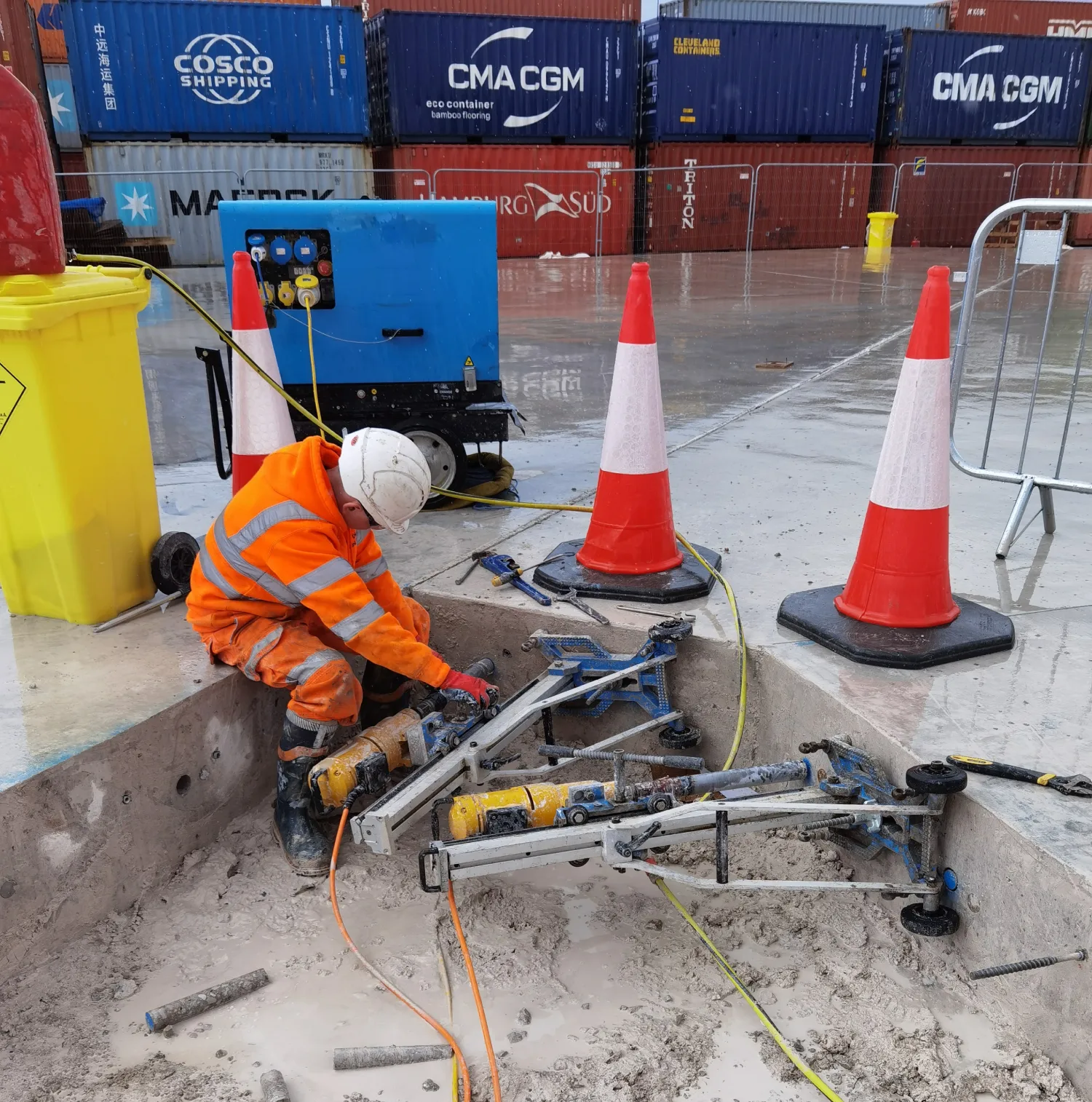
Diamond drilling is used to create clean, precise openings in concrete, reinforced concrete, brick, stone and other hard construction materials. It's most commonly used to install services such as pipework, electrical cables, ventilation systems and drainage, but it also plays an important role in refurbishments and new builds.
Because diamond drilling cuts through material rather than breaking it apart, it produces accurate openings with less vibration and disruption than many traditional methods.
Diamond drilling is a specialist technique that uses a hollow drill bit with industrial diamond segments on the end. As the drill rotates, it cuts through the material and removes a solid core, leaving behind a smooth, circular opening.
It can be used on floors, walls and ceilings, and is suitable for a wide range of construction materials, including reinforced concrete.
The size of the opening depends entirely on the project. It might be a small hole for an electrical cable, or a much larger opening for ventilation ducting or drainage pipework.
If you've ever looked above a suspended ceiling or inside a plant room, you've probably seen hundreds of pipes, cables and ducts running through concrete walls and floors. Almost every one of those services needed an opening creating before it could be installed.
That's where diamond drilling comes in.
It's regularly used to create openings for:
The aim isn't simply to make a hole. It needs to be the right size, in the right place and finished cleanly so the next stage of the project can continue without unnecessary delays.
Diamond drilling is used across both commercial and domestic projects.
On a construction site, it may be needed to create hundreds of openings for mechanical and electrical services before a building is completed. In a school or hospital, it can help contractors carry out improvement works whilst keeping disruption to a minimum.
For homeowners, the projects are often smaller but no less important. You might need an opening for an extractor fan during a bathroom renovation, pipework for an air source heat pump, or new services as part of a kitchen extension.
Although the projects are different, the requirements are usually the same. The opening needs to be accurate, and it needs to be created without causing unnecessary damage to the surrounding area.
Traditional drilling methods rely on impact to break through concrete. Whilst that approach has its place, it isn't always the best option when accuracy matters.
Diamond drilling works differently. It cuts through the material in a controlled way, helping to reduce vibration and produce a cleaner finish.
That can make a real difference on site.
For example, if a ventilation contractor is installing ductwork through a reinforced concrete wall, the opening needs to line up with the equipment on both sides. Even being slightly out can create extra work for the trades that follow.
The same applies on domestic projects. A homeowner installing underfloor heating or plumbing doesn't want unnecessary damage to surrounding floors or walls if it can be avoided.
Choosing the right drilling method from the outset can help keep the project moving and reduce the need for extra work later on.
Yes. In fact, reinforced concrete is one of the materials diamond drilling is regularly used on.
Modern buildings often contain steel reinforcement within the concrete, so every project should be assessed before work begins. Understanding what's inside the structure and selecting the correct equipment is an important part of completing the work safely.
Every building is different, which is why experience matters just as much as the equipment being used.
Not every project requires a specialist contractor. If you're fixing a shelf to a wall, standard tools are usually more than enough.
However, if you're creating larger openings, working with reinforced concrete or installing new building services, professional diamond drilling is often the safest and most efficient approach.
An experienced contractor won't just arrive with the right equipment. They'll consider the structure, the location of existing services and the requirements of the wider project before any drilling begins.
That planning helps avoid problems that could otherwise lead to delays, additional costs or unnecessary repairs.
At DP Diamond Drilling, we've been supporting construction projects for more than 50 years. We work with homeowners, contractors and businesses across the UK, providing specialist diamond drilling services for projects of every size.
If you're planning work that involves concrete or masonry and aren't sure which approach is right, our team will be happy to offer advice. We'll help you find the most practical solution for your project and carry out the work with the care and precision it's known for. Contact us today to find out more.