
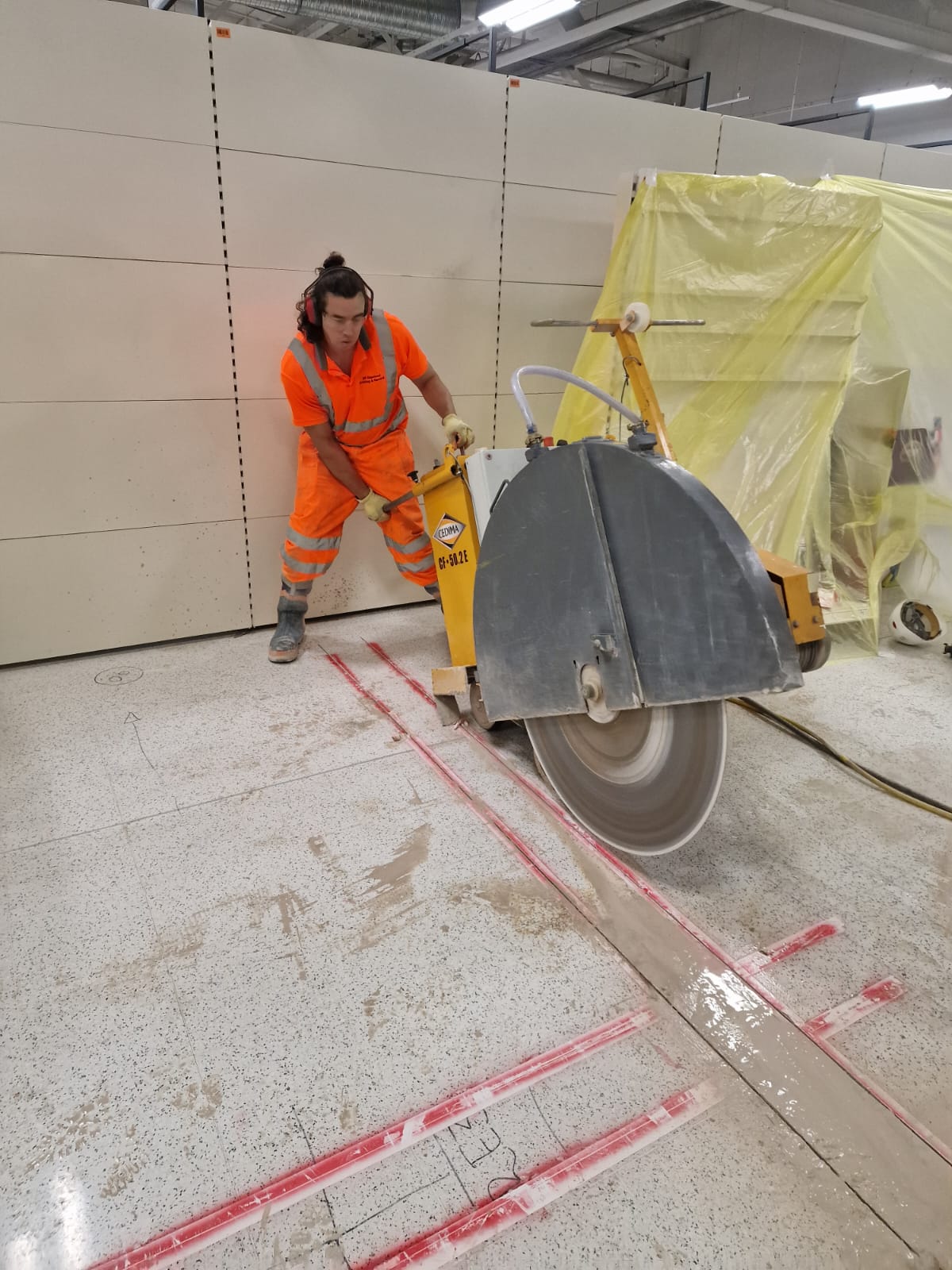
Floor sawing is a good choice when you need a clean, straight cut through a concrete or asphalt floor. It's commonly used for jobs such as creating service trenches, altering concrete slabs and removing sections of flooring where accuracy matters.
At DP Diamond Drilling, we use floor sawing to create precise, controlled cuts across flat surfaces, ensuring the area is ready for the next stage of the project.
One of the most common reasons for floor sawing is to make changes to an existing concrete slab.
Imagine new drainage needs to run through the floor of a warehouse. Rather than breaking out a large area of concrete, floor sawing can be used to cut along either side of the proposed trench. The section between those cuts can then be removed, leaving a much more controlled area for the new services.
The same principle can be useful for:
It's not really the size of the job that makes floor sawing suitable. It’s the type of cut that's needed and what needs to happen once we've finished that matters.
Sometimes concrete simply needs to come out and breaking methods are perfectly suitable. Other times, you need much more control.
If only one section of a concrete floor needs removing, breaking straight into it can affect more of the surrounding area than intended. Making defined cuts first gives you a clear boundary to work within.
It can also leave cleaner edges behind, which matters when the remaining floor is staying in place or another trade needs to work from the opening afterwards.
In our experience, thinking about what happens after the concrete has been cut is just as important as making the cut itself.
A line marked on a floor tells us where somebody wants the cut. It doesn't tell us what's underneath it.
Before we recommend an approach, we need to understand things such as how deep the cut needs to be and whether there could be reinforcement or existing services beneath the surface.
This is very important in existing buildings. Pipework, drainage and electrical services may already be running through or underneath the floor, and they're not always obvious from looking at the surface.
Taking the time to understand the area before work starts can prevent a much bigger problem later.
Not always. Floor sawing works particularly well for straight cuts on horizontal surfaces, but sometimes another method simply makes more sense.
If you need a circular opening for a pipe, for example, we'd be more likely to recommend diamond drilling. If the work involves a vertical concrete wall, a different sawing method may be more appropriate.
That's why we wouldn't recommend floor sawing just because there's concrete involved. The method should suit the job, rather than trying to make the job suit the equipment.
If you're planning to alter an existing concrete floor, particularly where other trades will depend on the finished cut, it's worth speaking to a specialist before work begins.
You don't need to know exactly which machine or cutting method you require. That's our job.
At DP Diamond Drilling, we'll look at what you're trying to achieve, the surface we're working with and what needs to happen afterwards before recommending the most practical way forward.
With more than 50 years of experience, we've worked across a wide range of commercial, industrial and domestic projects. If you're unsure whether floor sawing is right for your project, get in touch with our team and we'll be happy to talk it through.