
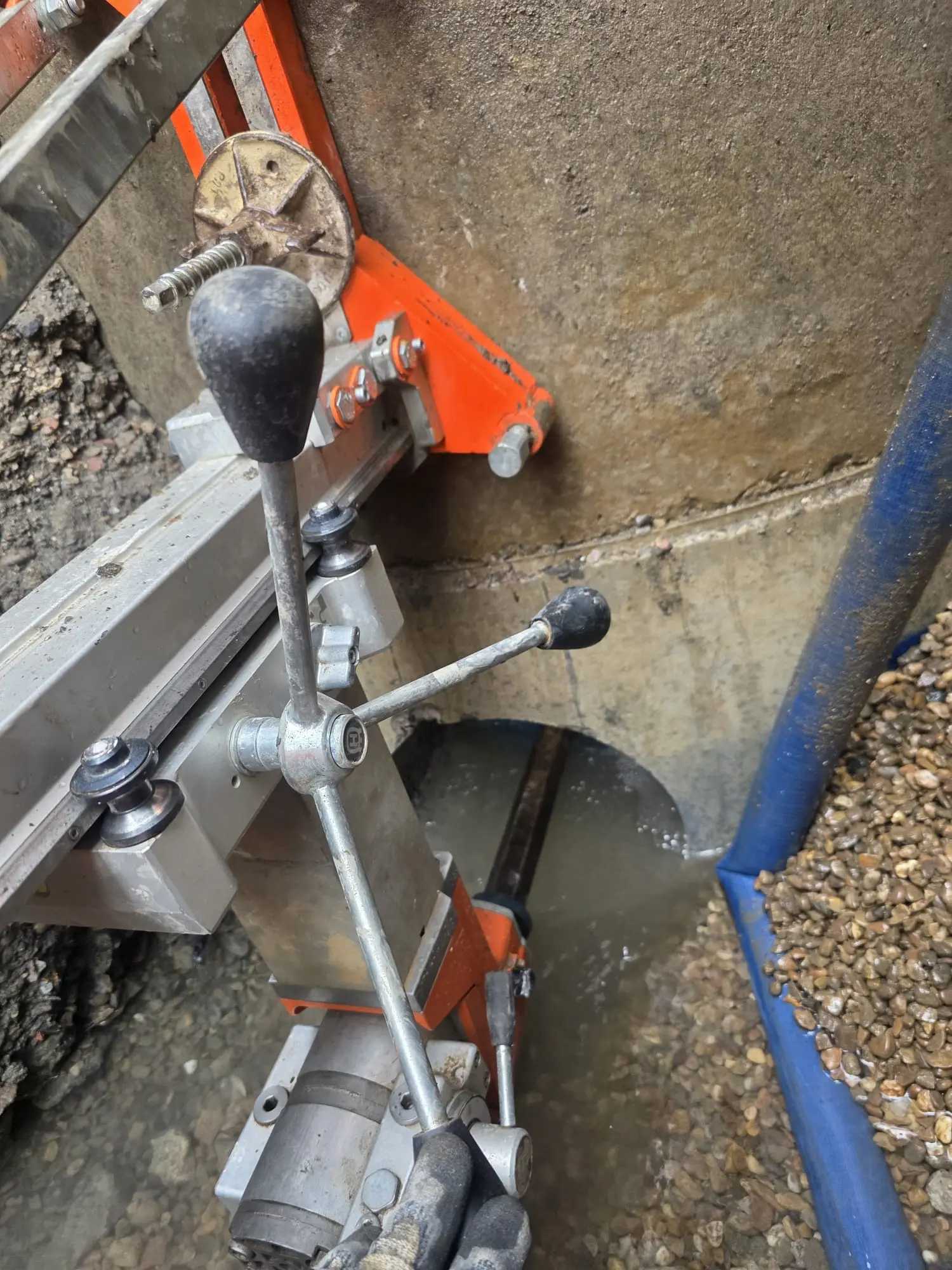
Concrete demolition has come a long way in recent years. Traditional methods involving jackhammers, breakers, and high-impact tools often create excessive dust, noise, and vibration - not to mention higher risks for workers and more disruption on-site. So, as construction sites become more safety-conscious and efficiency-led, contractors are turning to quieter, cleaner, and more controlled demolition techniques.
One of the preferred methods is hydraulic bursting. Known for its strength, precision, and low-impact nature, hydraulic bursting is quickly becoming one of the most popular ways to remove reinforced concrete in commercial and industrial settings.
As experienced diamond drilling contractors, we frequently pair hydraulic bursting with techniques such as concrete cutting and diamond drilling to create a safe and seamless demolition process. We’re here to explain what hydraulic bursting is, why it’s becoming the method of choice across the UK, and how your site can benefit from this approach.
Hydraulic bursting is a non-percussive demolition method that breaks concrete from the inside out. Instead of relying on force, the system applies continuous hydraulic pressure through burster heads that are inserted into pre-drilled holes. As the pressure increases, the concrete fractures along controlled lines, splitting into manageable sections without flying debris or uncontrolled cracking.
Because the method uses internal force rather than impact, it produces minimal noise, dust and vibration. This makes it ideal for commercial settings that cannot tolerate disruption, such as hospitals, manufacturing sites, office buildings, retail units and multi-storey developments.
One of the biggest advantages of hydraulic bursting is that it is much quieter than traditional tools. The only noticeable noise comes from the drilling stage, which is significantly less disruptive than jackhammers or excavator-mounted breakers. This low-noise characteristic makes hydraulic bursting suitable for live commercial sites, sensitive environments and locations where working hours are restricted.
It is also extremely low-vibration, meaning the surrounding structure remains stable throughout the demolition. This allows contractors to remove thick or reinforced concrete sections without worrying about structural movement or accidental damage to the areas that need to remain intact. For project managers, this level of predictability is invaluable.
Hydraulic bursting is also one of the safest methods available. Because the concrete cracks cleanly along controlled lines, there is no risk of flying fragments or sudden collapse. Operatives can maintain a safe distance throughout the process, which reduces workplace hazards and supports a cleaner demolition environment. When paired with water suppression during the drilling stage, the method produces very little dust and keeps the site visibly cleaner.
The technique is equally appealing from an efficiency perspective. Hydraulic bursting can break apart extremely thick or heavily reinforced concrete that traditional tools struggle to penetrate. The fractured concrete sections are easy to remove, speeding up the overall process and reducing labour time. And the best part? In many cases, hydraulic bursting allows concrete removal to take place without stopping other work on site - something that older methods often cannot achieve.
Finally, hydraulic bursting is considered an environmentally friendly option. It creates larger, predictable pieces of concrete that are easier to handle and recycle, while the reduced noise and dust contribute to a cleaner, safer site.
Hydraulic bursting is highly adaptable, making it suitable for a wide range of commercial and industrial applications. It is commonly used to dismantle reinforced beams, columns, foundations, staircases and slabs. On civil engineering projects, it tends to be used for controlled bridge demolition, concrete plinth removal, and the breaking down of large structural elements where vibration must be kept to a minimum.
Because the method is so controlled, it is often chosen for internal demolition inside occupied or partially open buildings, such as factories undergoing upgrades, retail units being reconfigured or older buildings being modernised. Its ability to break through thick reinforced concrete makes it a go-to technique for projects where strength and precision are equally important.
Hydraulic bursting is one of the quietest demolition methods available. The only noticeable noise comes from the initial drilling stage, which is significantly quieter than breakers or percussive tools. Once the burster heads are inserted, the cracking process happens internally, meaning the surrounding environment remains calm and undisturbed.
Yes, hydraulic bursting is perfectly suited to indoor demolition. Because it produces minimal dust, vibration and debris, it is ideal for enclosed or occupied spaces, including factories, retail units, office buildings and basements. Its controlled nature allows work to continue nearby, making it far more practical than high-impact demolition techniques.
Hydraulic bursting is designed to fracture extremely thick and reinforced concrete. It can break through several metres of concrete, depending on the specific structural conditions. Since the pressure is applied internally, the method is not hindered by dense reinforcement or concrete strength, which is why it is widely used on large commercial and civil engineering projects.
Yes. Before bursting begins, precise holes must be drilled into the concrete to position the burster heads. This is why the method is typically carried out by experienced diamond drilling contractors, who have the specialist equipment needed to create accurate openings safely. The success of the bursting process depends heavily on this initial drilling stage.
While it involves specialist equipment, hydraulic bursting is often more cost-effective overall. Because it is faster, cleaner and requires far less manual breaking, it reduces labour time and speeds up the overall programme. It also minimises disruption and the risk of accidental damage, helping project managers avoid delays and costly remedial work.
No. When carried out correctly, hydraulic bursting is one of the safest and most controlled demolition methods available. The process creates minimal vibration, meaning the surrounding concrete, floors, walls and structural elements remain stable. This makes hydraulic bursting especially useful in sensitive environments, where precision and protection of adjacent structures are essential.
Hydraulic bursting rarely operates in isolation. It is typically used as part of a wider demolition plan involving diamond drilling or concrete cutting. Drilling provides the precise holes needed for the burster heads, while concrete cutting can outline specific removal areas, create expansion cuts or separate the section being demolished from the rest of the structure.
This combined approach ensures that large or complex concrete elements can be removed cleanly and safely, with no unnecessary damage. The result is a predictable, controlled demolition sequence that supports the efficiency of the entire construction project.
Hydraulic bursting is highly effective, but it should only be done by trained professionals. The holes must be drilled accurately, the burster heads positioned correctly, and the pressure applied at a controlled rate. A poor understanding of structural behaviour can undermine the safety benefits of the method, which is why it should always be carried out by experienced demolition specialists.
Working with established diamond drilling contractors gives you the reassurance that every stage - drilling, bursting, concrete removal and clean-up - is completed to the highest standard. The right team will also ensure that the work aligns with safety regulations, site requirements and your overall project schedule.
At DP Diamond Drilling, we bring decades of experience to hydraulic bursting, concrete cutting and specialist drilling. Our teams work across the UK to support commercial demolition, refurbishment and structural alteration projects of all sizes. As a family-run business, we combine technical expertise with a dependable, personal service, ensuring every client receives the care and precision their project demands.
If you're searching for local diamond drilling experts to support hydraulic bursting on your site, we’re here to help. Contact DP Diamond Drilling to arrange a site visit and discuss the safest and most efficient way to break down concrete on your commercial project.