
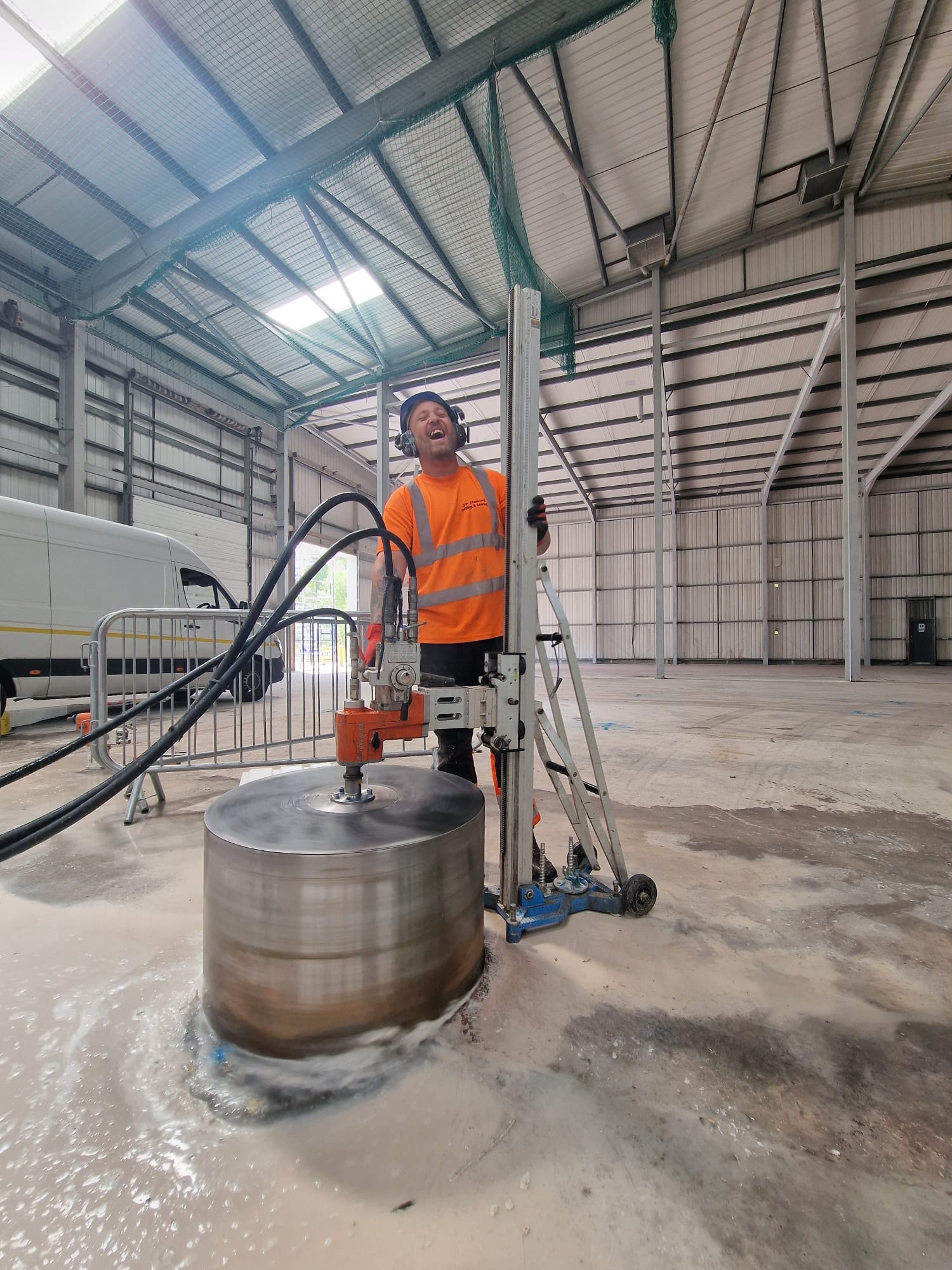
Mechanical and electrical installations rely on careful planning. Whether a project involves new pipework, ventilation, electrical cabling or other building services, those systems often need to pass through concrete floors, walls and other structural elements. And this is where core drilling comes in.
It’s vital to get the position of those openings right from the beginning. Because, a core hole drilled even slightly away from its intended position can cause problems for the trades following behind, from pipework that doesn’t align to services that need to be rerouted.
At DP Diamond Drilling, we regularly work alongside contractors and project managers to create precise openings for M&E installations. With over 50 years of industry experience, we understand how important it is for drilling work to fit into the wider construction programme and, most importantly, to get every opening right the first time.
On a busy commercial project, a core hole might seem like a relatively small part of the overall build. But its position can affect several different trades.
M&E systems are designed around specific routes, levels and connection points. If a penetration through a concrete slab or wall isn’t positioned correctly, the services intended to pass through it may no longer line up correctly. Resolving this issue can mean changing the service route, drilling another hole or carrying out additional remedial work.
But good planning reduces these risks.
By establishing the correct hole diameter, position, depth and angle before core drilling begins, contractors can create openings that match the requirements of the M&E design. It also gives diamond drilling contractors the information they need to select the right equipment and approach for the work.
Accurate drilling starts with accurate information.
Before core hole locations are marked, the latest approved M&E drawings should be checked to confirm where services are intended to run. This is particularly important on larger projects, where drawings and specifications can change as the build develops.
Working from an outdated layout can result in holes being drilled for services that have since moved or changed in size.
The drawings should establish the position of each penetration and provide information about the service passing through it. A ventilation duct, for example, may require a very different opening from electrical cabling or a smaller pipe.
Any uncertainty is best resolved before drilling begins. A few extra checks at this stage can prevent a lot more work later on.
M&E installations don't exist separately from the rest of the building. Structural elements, architectural features and other services all need to occupy the same space, which makes coordination essential.
Before drilling into concrete, proposed core locations need to be considered alongside the wider project drawings. This helps identify potential clashes before they become physical problems on site.
A planned opening might appear suitable on an M&E drawing but conflict with another service, structural feature or finished element elsewhere in the design.
Coordination between project managers, M&E contractors, structural teams and diamond drilling contractors helps ensure everyone is working from the same information. It also reduces the likelihood of last-minute changes once drilling equipment has already been set up.
Knowing where a hole needs to go is only part of the planning process. You also need to understand what may be within or behind the material being drilled.
Reinforced concrete can contain significant amounts of steel reinforcement. Existing buildings may also have electrical cabling, pipework and other services running through areas where new openings have been proposed.
These things all need to be considered before drilling starts.
Depending on the project and structural requirements, reinforcement or existing services might influence whether the original position can be used. Where a clash is identified, the proposed opening can be reviewed before any concrete is cut. This is much better than discovering a problem once drilling is already underway.
Core drilling can produce clean openings in a wide range of diameters, but choosing the right size is important.
The core hole needs to accommodate the service passing through it as well as any additional requirements specified by the project. Simply matching the diameter of a pipe isn't necessarily enough.
Insulation, sleeves and other components can all affect the final dimensions required. Fire stopping requirements might also need to be considered where services penetrate walls or floors.
Creating an opening that's too small can mean further drilling or alterations later. An unnecessarily large opening, on the other hand, removes more material than required and can create additional finishing work.
So, confirming the dimensions beforehand allows the core to be drilled correctly the first time.
Not every M&E penetration travels straight through a structure.
Some installations need openings to be drilled at specific angles to achieve the correct route or connection. Others may pass through particularly thick sections of concrete, requiring deeper drilling and different equipment.
These details should be established before work begins.
Diamond core drilling equipment can be positioned vertically, horizontally or at an angle depending on the requirements of the project. But the drilling team needs to know what’s required in advance so the equipment can be set up accurately.
Depth also affects the drilling process. Knowing the thickness and composition of the structure helps us select suitable core barrels and prepare the right setup before arriving at the drilling point.
A location might work perfectly on a drawing but prove a lot more difficult to reach once you're standing on site.
Diamond drilling requires enough room to position and secure specialist equipment. Restricted access, high-level drilling locations and other trades working nearby can all affect how easily a proposed core can be completed.
This becomes particularly important on projects where construction has already progressed around the drilling location.
Planning core holes early gives contractors more opportunity to consider access before permanent installations restrict the available working space. It can also help project managers schedule drilling at the most practical stage of the build.
If access is going to be challenging, identifying it early allows us to consider an alternative setup rather than encountering delays once work begins.
Construction programmes are busy, and M&E installation is rarely the only work happening on site.
Core drilling needs to be coordinated with the trades working both around the drilling location and on the opposite side of the structure. This helps keep the area safe and prevents drilling operations from interfering with other work.
Scheduling also matters because correctly timed drilling allows follow-on trades to begin their installations without waiting for penetrations to be created.
This is one of the biggest advantages of getting diamond drilling contractors involved at the right stage. When openings are completed accurately and on schedule, M&E teams can move straight into installation rather than losing time waiting for additional construction work.
The surrounding environment should also be considered when planning core hole locations.
Water-fed diamond drilling is commonly used when drilling into concrete because the water cools the equipment and captures dust during the cutting process. But, the resulting slurry needs to be managed properly.
On a new construction site this may be fairly straightforward, but extra planning can be called for in live buildings, finished areas or locations close to sensitive equipment.
In some environments, dry drilling may provide a more suitable alternative. Professional extraction equipment can capture dust close to the drilling point without introducing water to the area.
Considering these requirements beforehand helps us choose a method that works for both the structure and the surrounding environment.
Changes are a normal part of construction. Even with careful coordination, M&E layouts can be adjusted as a project develops.
When this happens, existing core hole plans should be reviewed before drilling continues.
Moving a service doesn't automatically mean an opening can simply be moved with it. The revised position may introduce new structural considerations or clashes that weren't present in the original design.
Taking the time to check revised locations protects the structure and prevents unnecessary drilling.
Experienced diamond drilling contractors, like ourselves, are used to working within changing construction programmes. Clear communication between teams makes it much easier to respond to those changes without slowing down the wider project.
Well-planned core drilling makes life easier for everyone involved in an M&E installation.
Accurate openings allow services to follow their intended routes, reduce remedial work and help follow-on trades stay on schedule. Just as importantly, careful planning means structural requirements, existing services, access and site conditions can all be considered before drilling starts.
At DP Diamond Drilling, we've been providing professional diamond drilling and concrete cutting services for over 50 years. Our CHAS-accredited team works with contractors, project managers and other trades to deliver accurate core drilling across commercial projects nationwide.
If you're preparing for an M&E installation and need reliable core drilling to support the project, get in touch with DP Diamond Drilling. We can discuss your requirements, work alongside your site team and make sure each opening is completed accurately and ready for the next stage of the build.