
Reinforced concrete is designed to be tough. And combining concrete with steel reinforcement creates structures capable of handling significant loads and lasting for decades, making it an essential material across commercial construction, infrastructure and major developments.
But what happens when you need to create a precise opening through reinforced concrete?
Drilling through heavily reinforced concrete requires more than a powerful drill. The position of the reinforcement, depth of the concrete and size of the required opening all need to be considered before work begins.
But with professional diamond drilling equipment and an experienced team, even heavily reinforced structures can be drilled cleanly and accurately.
At DP Diamond Drilling, we’ve spent over 50 years working with concrete across projects of all shapes and sizes. That experience allows us to select the right equipment and approach for each job, ensuring the surrounding structure is protected, while the required opening is created to specification.
Reinforced concrete combines concrete with steel reinforcement, commonly known as rebar. Concrete provides excellent compressive strength, while the steel helps the structure withstand tensile forces. Together, they create an extremely strong and durable building material.
You’ll find reinforced concrete throughout modern construction, including foundations, floors, walls, bridges, columns and major structural elements.
But the same strength that makes reinforced concrete so useful can make drilling through it more challenging. So, a standard masonry drill might initially make progress through the concrete before reaching steel reinforcement and struggling to continue.
Rather than relying on greater impact or force, professional diamond drilling provides a controlled way to cut through both materials.
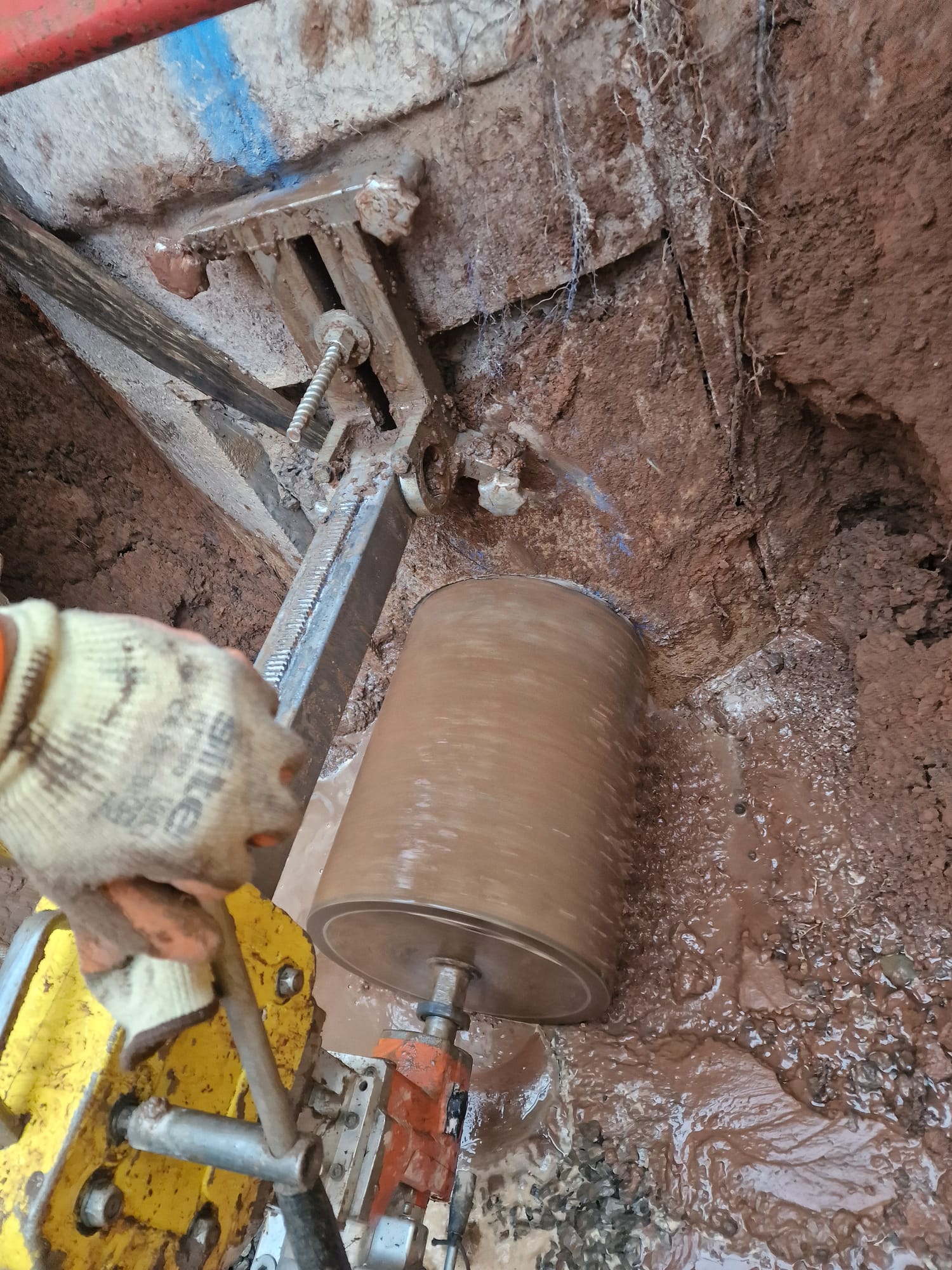
Diamond drilling uses a rotating core barrel fitted with industrial diamond segments. Instead of hammering away at the material, the equipment cuts through it.
This makes a big difference when working with reinforced concrete.
Diamond drilling can create accurate circular openings through dense concrete and, at the same time, cut through reinforcement encountered along the drilling path. The result is a clean core rather than a roughly broken opening surrounded by damaged material.
The non-percussive nature of the process also means considerably less vibration than traditional impact methods. When you’re drilling through an existing structural element, reducing unnecessary vibration helps protect the concrete surrounding the opening.
For commercial projects where dimensions need to be exact, this control is particularly valuable.
Before drilling starts, we need to understand exactly what we’re dealing with. Reinforced concrete can vary a lot between sites. So, making assumptions about what sits beneath the surface can cause unnecessary problems.
The required hole position, diameter and depth are considered alongside the structure itself. Existing services and other potential hazards also need to be accounted for before the equipment is set up.
Once the drilling position has been confirmed, the diamond drill and rig are securely mounted. A stable setup keeps the core barrel correctly aligned throughout the cut, which is especially important when creating deeper openings or working to tight tolerances.
As the diamond core drill moves through the concrete, it may encounter steel reinforcement. The diamond segments allow the equipment to continue cutting through the reinforced section rather than relying on impact to break through it.
This controlled process means we can create an opening that meets the required dimensions without unnecessarily disturbing the surrounding structure.
Rebar is one of the main reasons drilling reinforced concrete requires specialist equipment.
Traditional masonry equipment is primarily designed to work through masonry and concrete. This means that, once the drill reaches steel, progress can become much more difficult and trying to force the equipment through can result in poor-quality openings or unnecessary damage.
Diamond core drilling is different because the cutting equipment is capable of working through both concrete and reinforcing steel.
This doesn’t mean reinforcement should simply be cut without consideration. Its location and structural importance need to be understood as part of the wider project requirements. Where necessary, the drilling position can be reviewed before work proceeds.
For professional diamond drilling contractors, understanding what’s being drilled is every bit as important as having powerful equipment.
When suitable for the site, water plays an important role in drilling heavily reinforced concrete.
Cutting through dense concrete and steel generates heat. And to counter this, controlled water supply helps cool the diamond segments during drilling, supporting efficient cutting and helping to protect the equipment.
Water also captures much of the dust produced at the point of drilling. Instead of allowing fine concrete particles to become airborne and spread across the site, they’re contained within a manageable slurry.
This can make diamond drilling an especially practical option in live commercial environments where cleanliness and disruption need to be carefully managed.
There are situations where water-fed drilling may not be appropriate, including certain environments around electrical systems. Our team can assess the site requirements and select a suitable drilling method to fit.
The depth that can be achieved depends on the equipment, access and specific requirements of the project.
Diamond drilling is highly adaptable and can be used for everything from relatively small service penetrations to much deeper openings through substantial concrete structures. Different core barrel sizes and drilling setups allow experienced contractors to adapt the process to the dimensions required.
Depth is only one consideration, though. The diameter, angle and location of the opening can be just as important.
Your project might require a straightforward horizontal penetration through a wall, a vertical opening through a reinforced floor slab or an angled hole for a specialist service installation. Professional equipment gives us the flexibility to approach each of these requirements accurately.
Drilling through reinforced concrete is required across a huge range of commercial and infrastructure projects.
Mechanical and electrical installations regularly need openings for pipework, cables, ventilation and other building services. Drainage projects often require precise penetrations through existing concrete slabs, while refurbishment work can involve adapting structures to accommodate new layouts or equipment.
Diamond drilling is also useful when working in existing buildings because the accuracy of the process limits unnecessary removal. Instead of breaking out a much larger section of concrete to create access, a core can be drilled to the dimensions actually required.
For project managers, this means less remedial work and a cleaner opening ready for the next trade.
Commercial construction rarely happens in isolation. Other trades may be working nearby, parts of a building may remain operational, and deadlines still need to be met.
This is another area where diamond drilling has a clear advantage.
Because the process is non-percussive, it produces significantly less vibration than impact-based drilling. Water-fed systems can also control dust, helping us maintain a cleaner work area whilst surrounding work continues.
As a result, diamond drilling can be well suited to sensitive and live environments where excessive vibration, debris or disruption would create additional problems.
Accuracy also helps with project scheduling. A correctly positioned, cleanly drilled opening allows follow-on installations to proceed without contractors having to spend additional time correcting or finishing the hole.
Professional equipment is important, but it needs to be used by people who understand the material and the demands of the site.
Heavily reinforced concrete can present different challenges as drilling progresses. Operators need to understand the equipment, recognise changes in the material and maintain control throughout the cut.
Planning is equally important. Getting an opening wrong in reinforced concrete can create far more work than getting it right in the first place. Accurate positioning and an appropriate drilling setup reduce the likelihood of remedial work, wasted time and unnecessary disruption.
With over five decades of experience, our team has worked across a wide variety of commercial environments and understands the importance of getting these details right from the outset.
Drilling through heavily reinforced concrete might be challenging, but with specialist diamond equipment and experienced operators, it can be completed accurately and efficiently.
At DP Diamond Drilling, we provide professional diamond drilling and concrete cutting services for commercial projects nationwide. As a family-run business based in Warrington, we combine over 50 years of industry experience with modern equipment and a practical approach to every project.
Whether you need service penetrations through a reinforced wall, openings through a concrete floor slab or specialist drilling as part of a larger commercial development, our CHAS-accredited team can assess the requirements and determine the right approach.
If you have a project involving heavily reinforced concrete, get in touch with us today to discuss your requirements or arrange a site visit.