
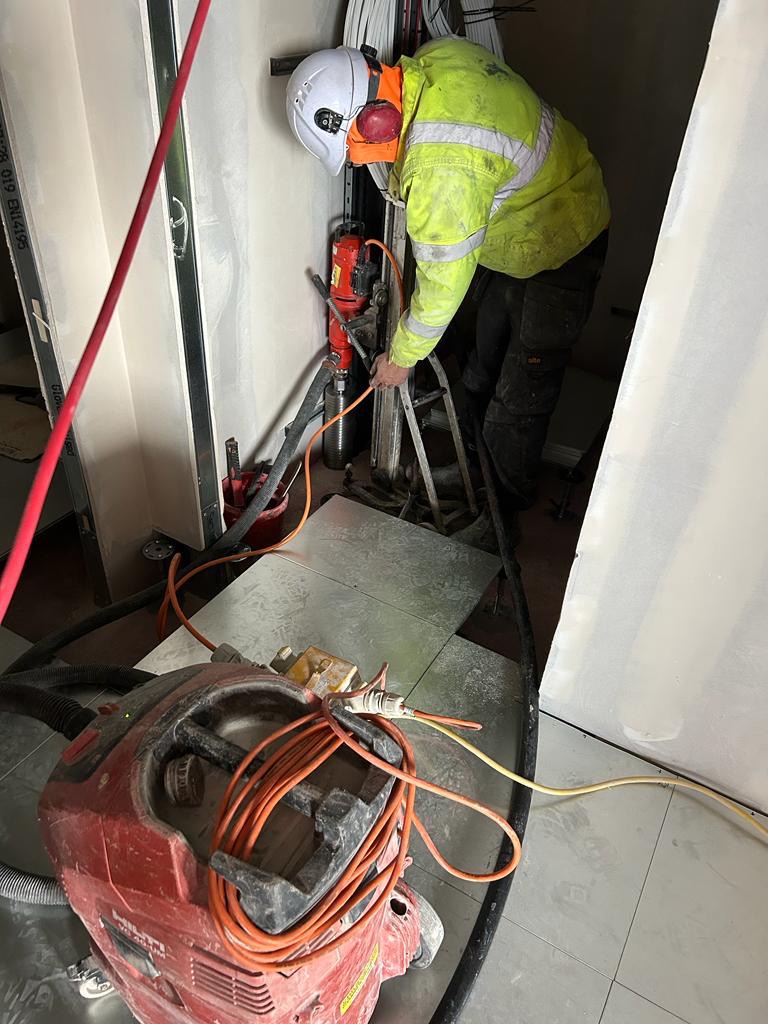
When planning a diamond drilling project, one of the decisions you need to make is whether to use wet or dry drilling. Both methods have their place. And choosing between them depends on the material being drilled, the surrounding environment and the requirements of the job.
Wet diamond drilling is widely used because water helps control dust and cool the equipment during cutting. But, there are plenty of situations where introducing water to a site simply isn’t practical. This is where dry drilling comes into its own.
At DP Diamond Drilling, we use both wet and dry drilling techniques across our projects. With over 50 years of experience, we can assess the site and choose an approach that delivers the accuracy required, while keeping disruption and mess to a minimum.
Dry diamond drilling uses specialist diamond-tipped equipment to cut through materials without a continuous water supply at the drilling point.
Like wet diamond drilling, it works through a cutting action rather than the repeated impact associated with traditional hammer drilling. This allows accurate holes to be created, while keeping vibration to a minimum.
The obvious difference is the absence of water. Because water isn’t being used to cool the equipment or capture drilling dust, professional dry drilling requires suitable equipment and effective dust extraction.
When carried out correctly, it provides a practical solution for environments where water could create problems or where keeping the surrounding area dry is particularly important.
Wet diamond drilling introduces a controlled supply of water to the drill bit as it cuts. The water cools the diamond segments and captures much of the dust generated during drilling, turning it into a slurry that can then be managed and removed.
For many concrete drilling projects, this is an efficient way to work. It’s particularly useful when drilling deep or larger-diameter holes through dense concrete and reinforced materials, where significant heat can be generated.
But wet drilling isn't automatically the right option for every project.
Site conditions can make water unsuitable, and sometimes the disruption associated with managing water and slurry outweighs its benefits. Experienced diamond drilling contractors, like us, will consider the complete working environment before deciding which technique to use.
One of the main reasons to choose dry drilling is when water needs to be kept away from the working area.
Electrical installations are an obvious example. If drilling is taking place close to electrical equipment or other sensitive services, introducing water may create unnecessary risks. Subject to the specific site conditions and safety requirements, dry drilling can provide a more suitable approach.
Finished interiors are another common example. If drilling is required as part of a fit-out or refurbishment, water and slurry may be difficult to manage around completed flooring, decoration or fixtures. A dry drilling setup with effective dust extraction can help keep the work contained.
Access can influence the decision too. Some locations simply don't have a practical water supply close to the drilling point. Others make water collection difficult. Rather than introducing additional equipment and disruption, dry drilling can offer a more straightforward solution.
Drilling doesn't always take place on an empty construction site. We regularly work in environments where buildings remain operational and disruption needs to be carefully controlled.
Schools, offices, retail spaces and other occupied buildings can all present situations where dry drilling is useful. Water needs to be managed carefully indoors, particularly where completed surfaces, furnishings or equipment are nearby.
With professional dust extraction, dry diamond drilling can keep debris contained close to the drilling point. This makes it possible to carry out certain works cleanly without introducing water into the surrounding space.
The right method will always depend on the site itself. What works well in one live building may not be suitable for another, which is why assessing the working environment ahead of time is so important.
If water isn't capturing the dust, it needs to be controlled another way.
Professional dry drilling equipment can be paired with specialist extraction systems that collect dust as it is generated. This is particularly important when drilling concrete, brick or masonry, where fine particles can otherwise spread quickly across the work area.
Effective extraction helps maintain a cleaner site and protects the surrounding environment. It also makes dry drilling considerably different from simply taking a standard drill to a wall without any form of dust management.
At DP Diamond Drilling, cleanliness is an important consideration, whether we're working wet or dry. Selecting the right equipment for the environment allows us to control the by-products of drilling instead of leaving other trades or clients with unnecessary cleaning afterwards.
There are still plenty of projects where wet drilling is the preferred technique.
When drilling through thick or heavily reinforced concrete, water helps keep the diamond equipment cool over longer drilling periods. This supports efficient cutting and helps prevent excessive heat from affecting the equipment.
Wet drilling can also be particularly effective for larger or deeper cores. The combination of cooling and dust suppression makes it well suited to demanding structural work where the drill needs to work continuously through dense material.
Where the site allows water and slurry to be controlled effectively, wet drilling provides a clean and efficient method for many commercial applications.
The important point is that neither technique is universally better. The right choice is the one that suits the specific project.
When the correct equipment and technique are used, dry diamond drilling can produce highly accurate openings.
Diamond tools still cut rather than hammer through the material, giving operators much greater control than traditional impact drilling. For suitable applications, this means holes can be created to the required diameter without unnecessary damage to surrounding surfaces.
The material being drilled does matter, though. Some dense or reinforced materials may be better suited to wet drilling because of the heat produced and the demands placed on the drill bit.
This is why professional diamond drilling contractors assess the material as well as the environment before choosing how to proceed. The aim isn't simply to use the most convenient method. It's to select the technique that will produce the right result safely and efficiently.
Dry drilling can be particularly useful for domestic work because homeowners understandably want to keep disruption inside their property to a minimum.
If a hole is required for ventilation, pipework, an extractor fan or another home improvement, the location may already be decorated or surrounded by finished surfaces. Using water isn't always desirable in these situations.
Specialist dry drilling and extraction equipment, like ours, can allow the work to be carried out in a much more controlled way, with dust captured close to the source and no wet slurry to manage afterwards.
Our domestic drilling services are available across the North West, East Midlands and North Wales, and our team can advise on whether wet or dry drilling is better suited to the work required.
Choosing between wet and dry drilling should never be based on just one factor.
The material, hole diameter, drilling depth, access, nearby services and surrounding finishes can all affect the decision. The presence of reinforcement may also impact which equipment is most appropriate.
A proper assessment allows these factors to be looked at before drilling begins. This means the team arrives prepared with the correct equipment and can complete the work without unnecessary changes or delays.
For larger commercial projects, this planning also helps drilling work fit around other trades and the wider construction programme.
The choice between wet and dry drilling ultimately comes down to the needs of the project. Wet drilling is an excellent option for controlling dust, managing heat and working through demanding concrete structures, while dry drilling provides an effective alternative where water would be impractical or unsuitable.
At DP Diamond Drilling, we're experienced in both techniques and select our approach based on the conditions we find on site. As a family-run business with more than 50 years of experience, we understand that accuracy matters, but so does completing the work cleanly, safely and with minimal disruption.
We provide commercial diamond drilling services nationwide, alongside domestic services across the North West, East Midlands and North Wales.
If you're unsure whether your project requires wet or dry drilling, get in touch with our team. We can discuss your requirements, assess the site where needed and recommend the most suitable method for the job.